All writing / Private Worlds
Essay 01 / 04 · Privacy & ownershipA More Personal Internet Might Be a Less Public One
What if a more capable digital life could also be a more private one?
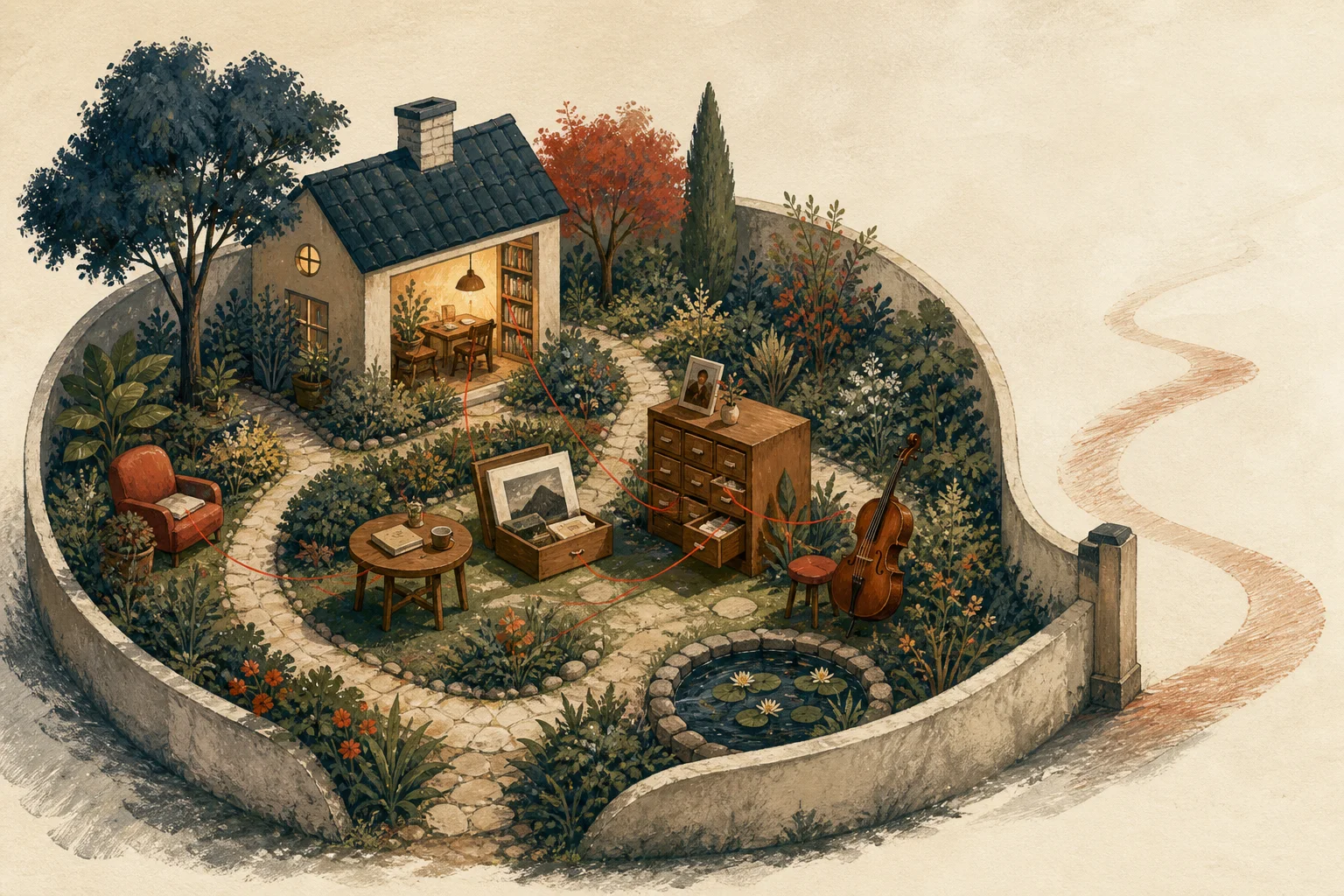
Taking a family website offline can be an act of technological ambition.
Consider the sequence: build a place for family history, photographs, health records, relationships, and an assistant that can make sense of them. Connect it to other services. Discover how much it contains. Then preserve the data and remove the public address.
The interesting part is that the ambition survives the shutdown. You still want the capabilities. You want to remember, create, coordinate, and understand. You have simply become more particular about where those activities belong.
Much of our experience with digital life has tied usefulness to participation in someone else’s platform. To share photographs, join the network. To organize information, adopt the service’s structure. Gradually, the places where we keep things become the places that decide how those things can relate.
A personal computing environment suggests another arrangement. Information can become useful through connections that matter to one person or household. A photograph can belong beside a place, a conversation, or a piece of music. Its value can be intimate and particular. It does not need an audience to justify the machinery.
Agents make this possibility more tangible when they help assemble and maintain tools that would otherwise demand too much specialist effort. Yet a capable assistant also makes the boundaries harder to see. A simple question—“What do my agents have access to?”—can require tracing browser sessions, command-line credentials, cloud services, and local files. Convenience can grow faster than our understanding of it.
That is where the romantic account of independence meets the practical one. A laptop can still depend on distant models, rented storage, and accounts that somebody else controls. Calling it personal does not settle the question of ownership.
Meaningful ownership has to include an exit: the ability to find the data, preserve it, understand its format, and change how it is used. It also includes the ability to withdraw something from public view without destroying its private usefulness.
Remove the audience.
Keep the world.
A public route and a private collection are different parts of a system. Change the route in this imagined household.
Your household
1 public route
4 private connections
4 retained collections
The public route is open. All four collections remain connected inside the household.
Conceptual map, not an inventory of actual services. Removing a route here changes no data. In a real system, private access and preservation must be checked separately; removing an address does not erase copies or past visibility.
Reading the comparison. Compare the two states: public route open → 1 public route, 4 private connections, 4 collections. Public route removed → 0 public routes, 4 private connections, 4 collections.
This offers a different direction for technological progress. A system can become more sophisticated while the public surface of a life becomes smaller. Greater connection can support greater discretion.
Perhaps a mature personal internet will be full of places that outsiders never encounter: elaborate, useful, carefully tended environments whose success is measured by what happens within them.
A family website disappears. The family keeps its world.