All writing / Private Worlds
Essay 04 / 04 · Technology & careThe Household Deserves Good Software
The real test of a personal system is whether ordinary life becomes easier for the people around it.
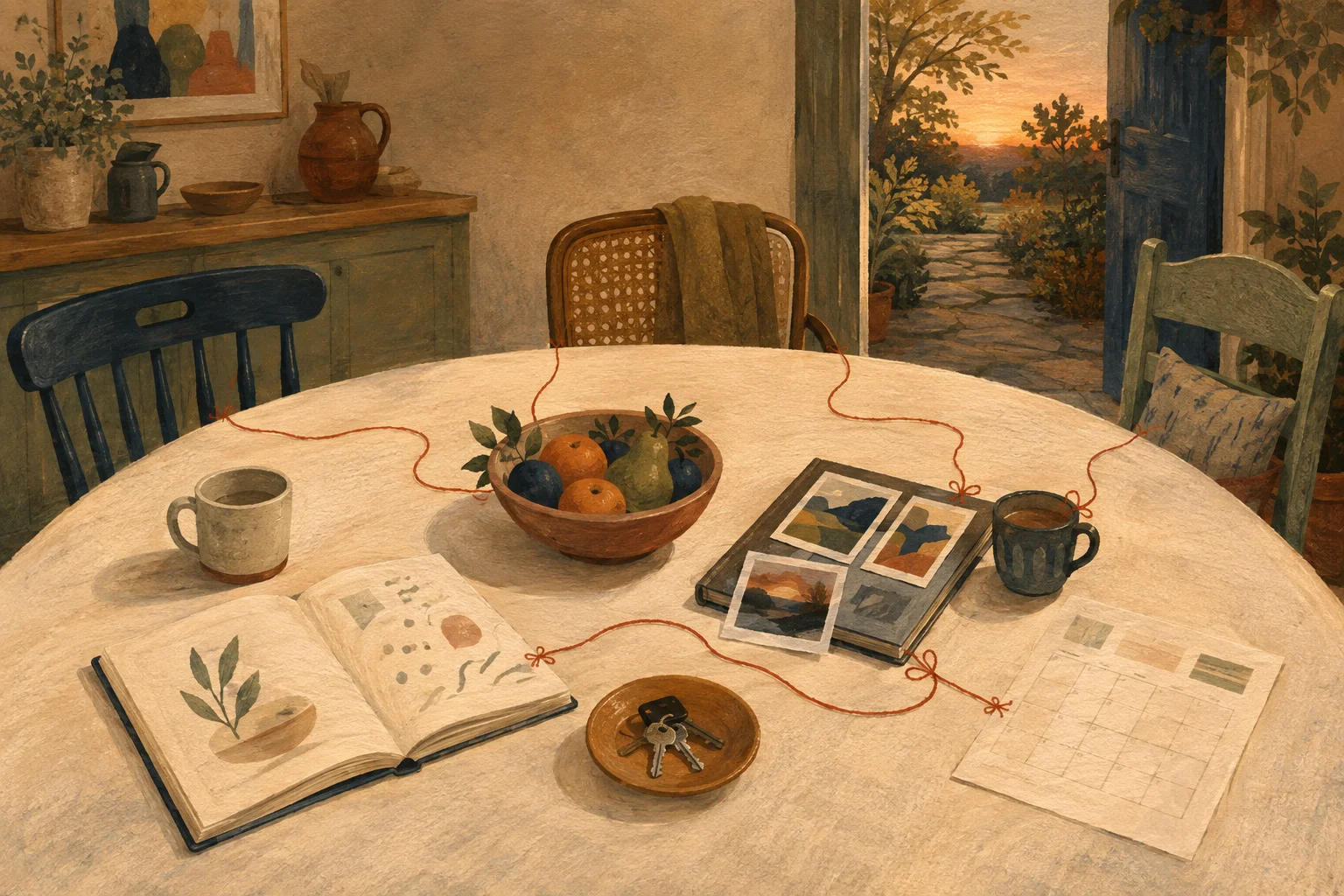
A household runs on a remarkable amount of information.
There are appointments, preferences, medications, repairs, school arrangements, meals, bills, photographs, and the countless small agreements that never become formal tasks. Someone knows where the document is. Someone remembers why the plan changed. Someone notices that a routine has stopped working.
Much of this coordination lives in people’s heads, distributed unevenly and often invisibly.
Building software around it is a serious ambition. A family’s time, attention, and continuity deserve thoughtful tools. A system that helps find an old photograph, prepare a meal, or recover the reason behind a decision can have value that no productivity report captures.
A personally assembled environment can begin with the household’s actual circumstances. It can accommodate particular routines, unusual interests, and information that crosses the boundaries between commercial applications. Its usefulness does not depend on how many other families would buy the same feature.
But the act of building it creates a second problem: someone becomes responsible for the system.
The person who understands the integrations may become the person everyone needs when something breaks. The calendar works until a credential expires. The archive remains accessible until a storage service changes. The assistant knows the arrangement until its model interprets a request differently.
A tool intended to reduce invisible labor can produce a new category of it.
This makes maintenance part of the human design. Can another household member understand the system? Can ordinary activities continue when the assistant is unavailable? Does a feature save enough effort to justify the attention it requires?
Who can pick up
the thread?
Imagine four everyday routines and two household members. Change whether their know-how is shared, then let the person who built the system take a break.
| Routine | Builder | Another member |
|---|---|---|
| Find a document | Can help | Needs a handoff |
| Change a plan | Can help | Needs a handoff |
| Recover an account | Can help | Needs a handoff |
| Fix a broken connection | Can help | Needs a handoff |
4 of 4 routines can continue, but all four depend on the same person.
A deliberately simplified, hypothetical household. “Shared” assumes the other person has the knowledge, permission, and practical ability to act; a document alone does not ensure this. The four blocks count routines with an available person able to carry them out. This is a continuity demonstration, not a measurement of care or workload.
Reading the comparison. When the builder is away, concentrated knowledge leaves 0 of 4 routines with a capable available person. Shared know-how keeps all 4 routines possible, assuming the other person also has permission and practical ability to act.
Power matters here too. The person who configures the defaults helps decide what gets recorded, which activities become visible, and whose preferences are easy to express. A household dashboard inevitably embodies somebody’s view of how the household works. That view needs to be open to revision by the people living inside it.
The opportunity is substantial precisely because the test is demanding. Good household software has to survive boredom, disagreement, tiredness, and imperfect participation. It must be useful to people who have no interest in the technology itself.
That is a more revealing challenge than a polished demonstration.
If agents can help sustain such systems, personal computing could become a practical form of care: remembering enough to relieve a burden, coordinating enough to make an outing possible, preserving enough to let a story be told again.
The achievement would show up in ordinary life. Someone has less to remember. Someone else can help. An evening becomes available.